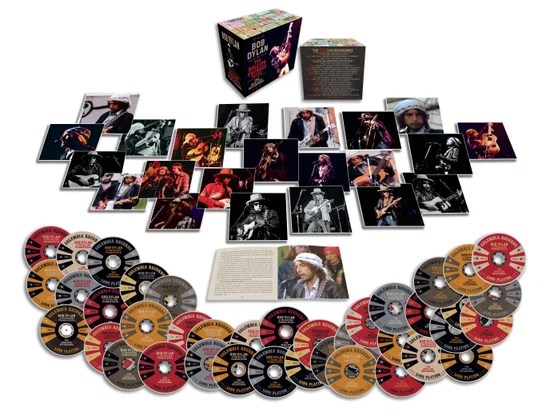
The 1976 Live Recordings presents the Rolling Thunder Revue at its rawest and most unfiltered. In-your-face! Across this vast and voluminous box set, many of the songs are transformed into unsettled, sometimes harrowing dramas of pain, frustration, grief and lovesick blues. Its significance lies not simply in the size of the archive, but in hearing Dylan reshape his work night after night. One question is whether—and, if so, to what extent—the life behind the performances helps us understand what we are hearing. Or whether we are simply listening to life, and life only.
Autobiographical?
“How can a song not be autobiographical?” Dylan once replied to a journalist who was asking the usual question. After all, all the songs came from the artist. Elsewhere, he insists that they are nothing of the kind: A song doesn’t have to be about his wife just because it is called “Sara”. Some years later, a journalist concludes that Dylan is addressing his own mortality in “Not Dark Yet”, and Dylan responds that the song is about everyone’s mortality, the one thing we all have in common. On another occasion, Dylan talks about gradually realizing that he had been writing about himself in passages where he had used “he”, “her” or “you” in the lyrics. All statements might be true at the same time. As a general rule, we should be very wary of drawing clear-cut, straight lines between biography and poetry, although all art is filtered through the artist’s lens. Sometimes the connections may seem obvious, while the roots of both art, reality and life are far more complex than we might—and would like to – believe.
Yet, when Dylan sets out for the second leg of his notorious Rolling Thunder Revue in 1976, it is quite difficult to deny the relevance of placing the tour in the context of the artist’s life. Here, we also have the blessing of some hindsight to draw upon.
Lot of water under the bridge, lot of other stuff too
After the motorcycle accident in July 1966, more than seven years passed before Dylan toured again. “I gave up art for family,” Dylan has been quoted, with some justification: his family grew rapidly, with children arriving in 1966, 1967, 1968 and 1969, making five of them, with Dylan’s adopted daughter Maria, Sara’s daughter from her first marriage. Maria was born in 1961.
Many songs were written and many albums released even during this extended paternity leave. A rough estimate will tell you that he wrote a place between 100 and 130 songs in a period that some see as lost years. Art, then, was still simmering on a lower flame, because it was not until January 1974 that he returned to the road, a very important part of his artistic work, this time with The Band. That same year, Dylan wrote and recorded the songs of what many people, this reviewer included, consider his greatest album, “Blood on the Tracks”, released January 1975. Although it has often been described as the ultimate “divorce album”, it unfolds a broad spectrum of emotions encompassing both love’s nature and its darker workings, almost certainly inspired by more than one relationship. Dylan has also spoken openly about how he and his wife began drifting apart and stopped understanding each other in 1974, before or during the writing of “Blood on the Tracks”. But there was no divorce in 1975. Dylan’s divorce from Sara first came in 1977, with custody of the children awarded to their mother. This year’s release, The 1976 Live Recordings, captures the intervening year, a context worth keeping in mind as we dive into this part of Dylan’s work as a live artist.
Following the critically acclaimed launch of the Rolling Thunder Revue in 1975 – a traveling circus of a caravan, led by Dylan and Joan Baez—the 1976 tour emerges partly as a continuation, but also as the previous year’s punk-inflected twin and opposite: uncompromising and far harder-edged, some might say darker. Dylan lays bare his soul with a rare intensity of delivery, often conveying far more pain, and at times more sorrow, than before, with obvious flashes of frustration, anger and bitterness in some of the songs. This artistic expression casts the entire tour in a distinctive light. Reliving it across these 39 CDs is a powerful, sometimes unsettling experience in its raw nakedness. The pain is partly shouted, partly sung, still marked by Dylan’s singular gift for phrasing, but in a way we have never heard before. Scarlett Rivera remains on violin, reinforcing this unique musical expression with every stroke of her bow, alongside most of the previous year’s band, named “Guam”, though with a more rock-driven sound than in 1975. During preparations and rehearsals, just nine days before the tour began, Dylan learned that Phil Ochs, an old friend but also a rival, had taken his own life. The news affected Dylan deeply, surely not least because he had felt compelled to turn down Ochs’s request to join the previous year’s tour because of his mental health and extensive substance abuse problems. Another element in the backdrop to the tour under discussion here. Life is hard, and then you die.
How can I explain, it is so hard to get on
When Dylan takes the stage in Lakeland on April 18, alone with his guitar, he sets the tone with a magnificent rendition of one of his absolutely greatest and most heartbreaking songs, “Visions of Johanna”, which he then had performed only once since 1966. The song was first recorded just a few days after the wedding of Bob Dylan and Sara in November 1965. The speculations of a who’s who in the song has run high through the years, not least the theory about Joan Baez as a possible model for “Johanna”, and at the same time Sara as a possible model for “Louise”. We’ll never know, of course, and the complexity of the song is in itself a warning about easy conclusions. Still, the fact that Sara is not in the audience this opening night, in contrast to Joan Baez, who still is present, both singing her own set and singing several duets with Dylan, adds to a dramatic build-up for the tour, and the feeling of that something’s wrong. Dylan’s changed mood from the fall of 1975 seem to be part of the mystique and a possible explanation of the sudden change of heart and temper characterizing this particular part of Dylan’s live history. Still, all those songs, even the centerpiece of the canvas, “Idiot Wind”, consists a broader set of pressure than what comes from inside, what comes from a relationship, as the song’s opening describes in detail. The dirt of gossip and the dust of rumors, all kinds of distractions are juxtaposed into a description of the complexity of the I’s life. It really might be more than one or two idiots included in this scenario, filtered through an I, but then again, when does “you” mean “I” in this song? The Austin version is close to an exorcism, in the Hattiesburg version you listen to pure exhaustion, underlined by a few moving spoken words, you’ll also find a great performance in Wichita. The versions in Fort Worth and Fort Collins are of course mandatory to listen to, but both for this song and many others, there is a possible path that will be less traveled through this box set, both when it comes to performance, phrasing, temper and lyrics. Try to find it.
Likewise the shows as a whole, with almost fifty different songs, displays a worldview that goes far beyond the purely introverted and relational, as when Woody Guthrie’s deeply empathetic “Deportees” is brought up between the duets, and we get to hear songs as “I Pity The Poor Immigrant”, “Blowing In The Wind”, “The Times They Are A-changin'”, “It’s Alright, Ma (I’m Only Bleeding)” and “A Hard Rain’s A-Gonna Fall”. The inner and the outer world is all in the mix, even though there might be some dominant main themes and main moods present.
Back to the starting point!
Back to the opening show. “Visions of Johanna’s” elaboration of longing and grief for a love that once existed and has been lost, becomes in the opening show a tremulous prologue to what is to come. This is reinforced by the live debut of “If You See Her, Say Hello”, with substantially rewritten lyrics steeped in both grief and bitterness: “You might say that I’m in disarray and for me time’s standing still/Oh I’ve never gotten over her, I don’t think I ever will”.
His inclusion, for the first and only time, of “Weary Blues from Waitin’” by Hank Williams—his first idol and the undisputed king of songs about lost and unrequited love—only underlines the scenario at hand: “These blues have got me cryin’/Oh, sweet mama, please come home”. Unfortunately, the first live performances of the classics “Idiot Wind” and “Shelter from the Storm” from this first show are not included in the box set, while both appear in incomplete recordings from the concert held just two days later, luckily later in many complete versions. It is interesting that several of the strongest, and presumably most personal songs on “Blood on the Tracks” were not played on the 1975 tour but are first gaining a prominent place in the shows in 1976. Just two of the songs were played fall 1975, seven of them was played during the spring tour in 1976. The time was ripe; life caught up with art. Or vice versa.
Blood on the Tracks
Of the 381 tracks made available here, only 10 of them has been previously released, 9 of them on the live album “Hard Rain” (1976), the song “Seven Days” on Bootleg Series 1-3, (1991). Nevertheless, the box set offers far greater variety than this introduction might suggest. Songs from all of Dylan’s 1960s albums are included, albeit in new arrangements and sometimes with revised lyrics. The concerts also feature songs from “Pat Garrett & Billy the Kid”, “Planet Waves”, from the mentioned “Blood on the Tracks” and the newest one, “Desire” (written and recorded in 1975, but released in 1976), alongside a fine selection of cover versions and songs from the folk tradition, mostly performed as duets with Joan Baez in a dedicated section of each concert. The cover of the beautiful “Spanish Is the Loving Tongue”, a song Dylan returned to several times throughout his career, first time in a basement in Woodstock, appears here in its only live performance. Wonderful to hear it in pristine sound. All in all, we can state that while the 1975 tour was more of a “Desire” tour, introducing eight of the songs of an album not released, while, as before mentioned, it was 1976 that became the real “Blood on the Tracks” tour, both when it comes to the mood of the renditions and the number of songs from the album used. The times they were-a-changin’.
The Rolling Thunder shows of 1976 consisted mostly of seven different parts: 1) The backing band, “Guam”, opens with songs from the band members. 2) Dylan’s first set, both solo acoustic and with the band, 3) guests, like Kinky Friedman, playing some songs, 4) Joan Baez solo set, 5) Duets by Joan Baez and Dylan, 6) Dylan’s rocking main set with the band and 7) all artists together on stage for the finale, with songs like “Knockin’ on Heavens Door”, often with Dylan and Roger McGuinn, and “Gotta Travel On” with all artists. The box set’s focus is obviously on Dylan’s performances (2, 5, 6 and 7). The whole shebang could last between 3.5 and 4 hours, sometimes more. A marathon. For historical reasons it of course could have been both fun and interesting to have a complete show documented, but I guess that would be a more complicated project, and I really don’t know how many of the full shows that were recorded properly.
We got all Dylan’s performances from 1976, both solo and in duet, in this set, as far as the professional recordings allow. Sometimes they ran out of tape and missed some songs, or some endings of songs. The major omission is the closing concert in Salt Lake City, which took place after all the recording equipment had been sent home. (Gallingly, since the concert is said to have included the only live performances of both “Lily, Rosemary and the Jack of Hearts” and “Black Diamond Bay”.) But, be aware, there is plenty to savor here. The Fort Worth concert, for instance, is included in its entirety, in superb sound. The blistering, high-tempo rendition of “Isis” is a revelation. “One Too Many Mornings” is elevated into an existential drama with the full band, as is the heartbreaking “I Threw It All Away”. A great show! We also get the second source for the “Hard Rain” album, the last show of the tour at Fort Collins, the one also filmed for the “Hard Rain” TV special, after Dylan’s veto against the show filmed at the Bellevue Hotel from the early part of the tour. Worth mentioning is the nine-minute version of “Tangled Up in Blue” on the final CD, delivered as though the Grateful Dead were backing Dylan, as they came to do on a mini-tour 11 years later. Fabulous version. There are lots of golden moments, too many to mention, some from Dylan’s solo acoustic set, some from the duets and of course many of the full band versions of some of the deepest, strongest and sometimes darkest performances. The solo version of “The Times They Are A-Changin’” from the show at Bellevue hotel, a beautiful duet with Joan on “I Dreamed I Saw St. Augustine” from the same show (disc 5) shows some of the magic in the different sets. The same can be said of the haunting band version of “One Too Many Mornings” from Orlando (disc 6). From the same show a quite slow version of
“You´re Gonna Make Me Lonesome When You Go” (disc 7), every word sung with the heavy weight of meaning and importance, then followed by the both raw, tender and begging “who really cares”-version of “Lay, Lady Lay”. A breathtakingly sad and gorgeous “I Threw It All Away” in Gainesville (disc 9) makes it almost impossible, for the moment at least, not to hear the song autobiographically. The song is followed by the only rocking and lonesome version of “Just Like Tom Thumb’s Blues” this tour. One of twelve songs only appearing once at the tour. The drama in the version of “Going, Going, Gone” with lyrical changes customized to the situation, makes it a journey through dark heat, like in Fort Worth with verses like this:
“I’ve just reached a place
Where the willow don’t bend
There’s no more to be said
It’s the top of the end
I’m in love with you, baby
But you’ve got to understand
That you want to be free
So let go of my hand
I’ve been sleeping out on the road
With my head in the dust
Now I just got to go
Before it’s diamonds and rust”
Joan Baez released her song “Diamonds And Rust” a year before, a beautiful and very touching song sparked by, as she herself has told, by an unexpected phone call from Dylan in January 1975. Tight connections to her heart, indeed.
Sing in me, Oh Muse, and through me tell the story
T-Bone Burnett played in Dylan’s band on both Rolling Thunder tours and discusses these years in the booklet accompanying the box set. After reflecting on the tour’s punk attitude and how Dylan these years helped open a door for many new musicians, he concludes: “Dylan had done it again. He is good at walking through doors that no one else had even seen, doors that others think are walls.”
A more substantial essay comes from Dylan authority Mikal Gilmore. He describes the tour as a Homeric drama, a view readily endorsed and borne out, not least, by the central place of “Idiot Wind” in the concerts: a complex odyssey of more than ten minutes through tempestuous relationships, directed at times towards a “you”, but ultimately acknowledging that it is also about a “we” being slowly shattered. Here we can listen to one of Dylan’s greatest works and performances evolve across 21 different live versions, with many changes in both lyrics and delivery.
“I’ve been double-crossed now
For the very last time and I think I finally see
I’ll kiss goodbye the howling beast
On the borderline which separated you from me
You’ll never know the hurt I suffered
Nor the pain I rise above
And I’ll never know the same about you
Your holiness or your kind of love
And it makes me feel so sorry“
Worth a study. A long time has passed since the sorrowful versions first recorded in New York in September 1974. About “Tangled Up In Blue” he later explained that this was a song that took ten years to live and two years to write. Attending the first show of the “Lights of Autumn Tour” in Oslo in October, we learnt that he, more than fifty years later, is still writing that song. Still in a state of becoming. As he was in 1976. Hard times, hard rain and hard travellin’, too.
When Dylan in 2015 was asked about what was his best song of heartbreak, he answered “Love Sick”, a song written about twenty years after this 1976 tour. The sentiments of the last verse is perhaps the most perfectly distilled essence of heartbreak ever. The duality and the conflicting emotions that exist side by side, it’s all there in some short lines. In my opinion they also sums up some of the core of this tour and this box set.
“I’m sick of love…I wish I’d never met you
I’m sick of love…I’m trying to forget you
Just don’t know what to do
I’d give anything to be with you”
And Hank Williams applauds from the tower of song….
Epilogue
The year of 2026 is the anniversary of the 1976 tour, but it also, on a personal level, is my own 50th anniversary of being under Bob Dylan’s spell, then after being introduced to the newly released “Desire”. It was this unique and authentic voice, crying in the wilderness, that got to me, long before I understood the depth of the lyrics. Fifty years later the same voice moves me, and with this box it brings me back to 1976, with songs and performances that never turn a blind eye to human nature, autobiographical or not.
It undoubtedly takes a certain stamina to work through Dylan’s vast archival releases, treasure chest after treasure chest. But when it comes to this particular box, this reviewer can report abundant quantities of gold. A true gift!
Johnny Borgan
P.s. For a more detailed overview of songs and performances in the box set, see my blogpost “Just Waitin'”. D.s.

